Critical Optimism logo

Framework

The STEPS Framework

A shared language for students, educators, and families.

What the Framework Is

The STEPS Framework is built on a simple premise: the capacities that allow students to participate in challenging academic environments are teachable skills, not fixed traits. When those skills are taught explicitly, practised deliberately, and named consistently across home and school, students develop the regulatory and metacognitive tools that make learning possible. How the Framework Works: The Five STEPS Skills

The STEPS Framework organizes skill-building around five functional domains — each addressing a specific barrier that frequently prevents students from engaging successfully with learning.
START — when stuck
PAUSE — when escalating
RESET — when overwhelmed
RECOVER — when things go wrong
REFLECT — to improve next time

The Framework in Practice STEPS skills are taught in context — during actual moments of difficulty, not as abstract lessons. Students practice 1-2 tools from each domain, building a personalized toolkit of 10-15 strategies they deploy automatically. What makes the framework work is systematic, scaffolded, and named implementation across every adult in a student's day. When students hear the same language and receive the same support structure from teachers, counselors, parents, and administrators, the skills generalize and become automatic regulatory capacity.

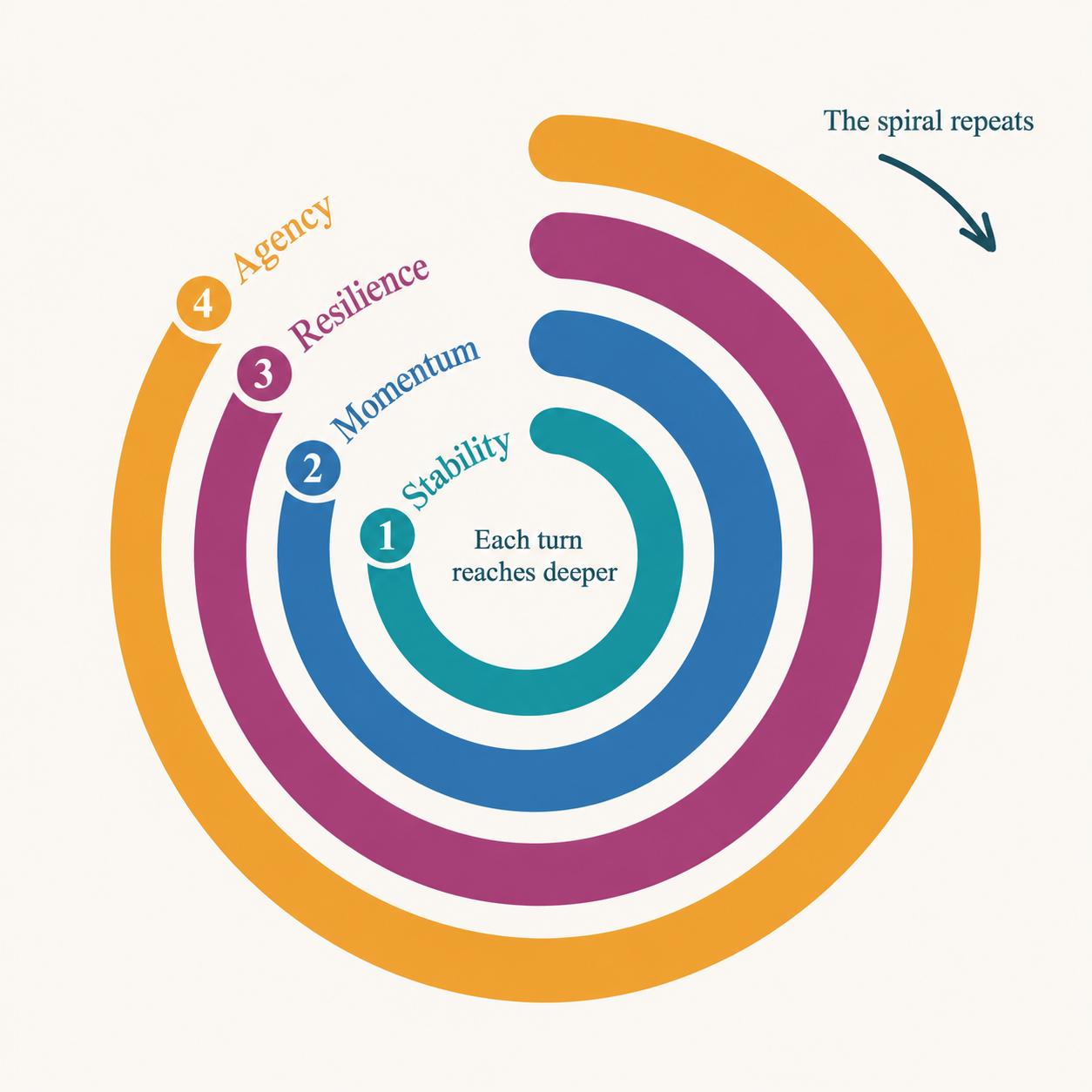
Illustration of the STEPS Spiral showing Stability, Momentum, Resilience, and Agency.
The same spiral repeats across the framework: each skill is revisited at increasing independence.

The STEPS Skills

Five skills. Used again and again. At increasing independence.

Task initiation is not a character trait. For many students, beginning is the hardest moment of any learning task, not because they are unwilling, but because the brain's systems for initiating action require working memory and inhibitory control that may be strained. Start is the skill that moves a student from frozen to in motion.

Adult support: Name the smallest possible first action. Do not assign the whole task. Assign the first step only.

What Start looks like across the Spiral
CycleWhat Start looks like
StabilityThe adult provides the starting prompt and sometimes takes the first step alongside the student.
MomentumThe student recognizes they are stuck and asks for help starting.
ResilienceThe student uses a self-designed starting routine independently.
AgencyThe student starts without prompting and can coach others who are stuck.
Illustration of the STEPS Spiral showing Stability, Momentum, Resilience, and Agency.

Escalation is a neurological event before it is a behavioral one. Before a situation becomes irreversible, Pause interrupts the escalation pathway and gives the thinking brain time to re-engage. Pause is a regulatory tool, not a compliance strategy.

Adult support: Model Pause visibly. Name it aloud when you use it. Never use Pause as a consequence.

What Pause looks like across the Spiral
CycleWhat Pause looks like
StabilityThe adult names the escalation and offers the pause.
MomentumThe student can identify escalation when prompted and attempt a pause.
ResilienceThe student pauses independently before situations escalate.
AgencyThe student recognizes escalation patterns in advance and prevents them.
Illustration of the STEPS Spiral showing Stability, Momentum, Resilience, and Agency.

Overwhelm is a state, not a deficiency. Reset does not ask the student to return to where they were before they became overwhelmed. It restores the minimum conditions for re-engagement, whatever those are for this student, right now.

Adult support: Hold the space without filling it. The student leads the reset. The adult ensures the environment is safe enough for it.

What Reset looks like across the Spiral
CycleWhat Reset looks like
StabilityThe adult structures the reset through an environment change or co-regulation activity.
MomentumThe student requests a reset when needed.
ResilienceThe student executes a self-designed reset routine independently.
AgencyThe student returns from a reset and re-engages without adult intervention.
Illustration of the STEPS Spiral showing Stability, Momentum, Resilience, and Agency.

Error tolerance is a learnable skill. Students who have accumulated significant educational discouragement have often learned that mistakes are permanent and defining. Recover teaches students to treat setbacks as information rather than verdicts.

Adult support: Use three questions. What happened? What do I need? What is my next step?

What Recover looks like across the Spiral
CycleWhat Recover looks like
StabilityRecovery is co-regulated with an adult who names what happened.
MomentumThe student can articulate what went wrong with adult support.
ResilienceThe student recovers and re-engages without adult intervention.
AgencyThe student views setbacks as data and adjusts their own systems accordingly.
Illustration of the STEPS Spiral showing Stability, Momentum, Resilience, and Agency.

Metacognition, the capacity to observe one's own thinking, is what makes all other skills transferable. Without Reflect, each session starts from zero. With it, learning accumulates.

Adult support: Close every session with Reflect, even briefly. One thing learned. One thing to try differently. One thing noticed about how I worked today.

What Reflect looks like across the Spiral
CycleWhat Reflect looks like
StabilityReflection is teacher-led and brief.
MomentumThe student completes a structured reflection prompt.
ResilienceThe student generates their own reflective questions.
AgencyThe student maintains an ongoing reflective practice and uses it to set goals.
Illustration of the STEPS Spiral showing Stability, Momentum, Resilience, and Agency.

The STEPS Spiral

Four cycles of development, revisited at increasing independence.

Student development rarely progresses in straight lines. Skills strengthen, are tested, sometimes fracture, and rebuild. The STEPS Spiral describes this process. The Spiral is not a level system. A student is never “a Stability student.” They are a student currently in Stability for this skill, in this context, right now.

Stability

The student is building a regulatory baseline. Basic routines are not yet established. The primary task is co-regulation and the creation of predictable structure.

  • Skills are prompted by adults, not yet self-initiated.
  • Transitions and new demands require explicit preparation.
  • Relationship and consistency are powerful interventions.

Adults do: Provide the structure. Co-regulate actively. Do not interpret dependence as weakness.

Momentum

The student has a baseline. Routines exist but are fragile. Skills are being practiced with support. The primary task is consistent application in low-stakes contexts.

  • Skills are used when prompted. Some spontaneous use begins.
  • The student can name what they need with adult guidance.
  • Small repeated successes build confidence.

Adults do: Prompt without rescuing. Celebrate consistency. Increase challenge gradually.

Resilience

The student can recover from setbacks. A difficult day does not derail the week. The primary task is consolidating independent regulation.

  • Skills are used independently in familiar contexts.
  • Feedback is received constructively.
  • Recovery time after difficulty has shortened.

Adults do: Step back. Offer support when asked. Name progress explicitly so the student can see it.

Agency

The student initiates independently. They plan, self-advocate, and act on their own goals with decreasing adult support. The primary task is transferring ownership from adult to student.

  • Skills are initiated without prompting.
  • The student monitors their own progress.
  • The student can support peers using the same skills.

Adults do: Consult rather than direct. Celebrate initiative. Prepare the student for the next environment.

Educator Reflection

Which STEPS skill do you find hardest to consistently implement?