Spiral
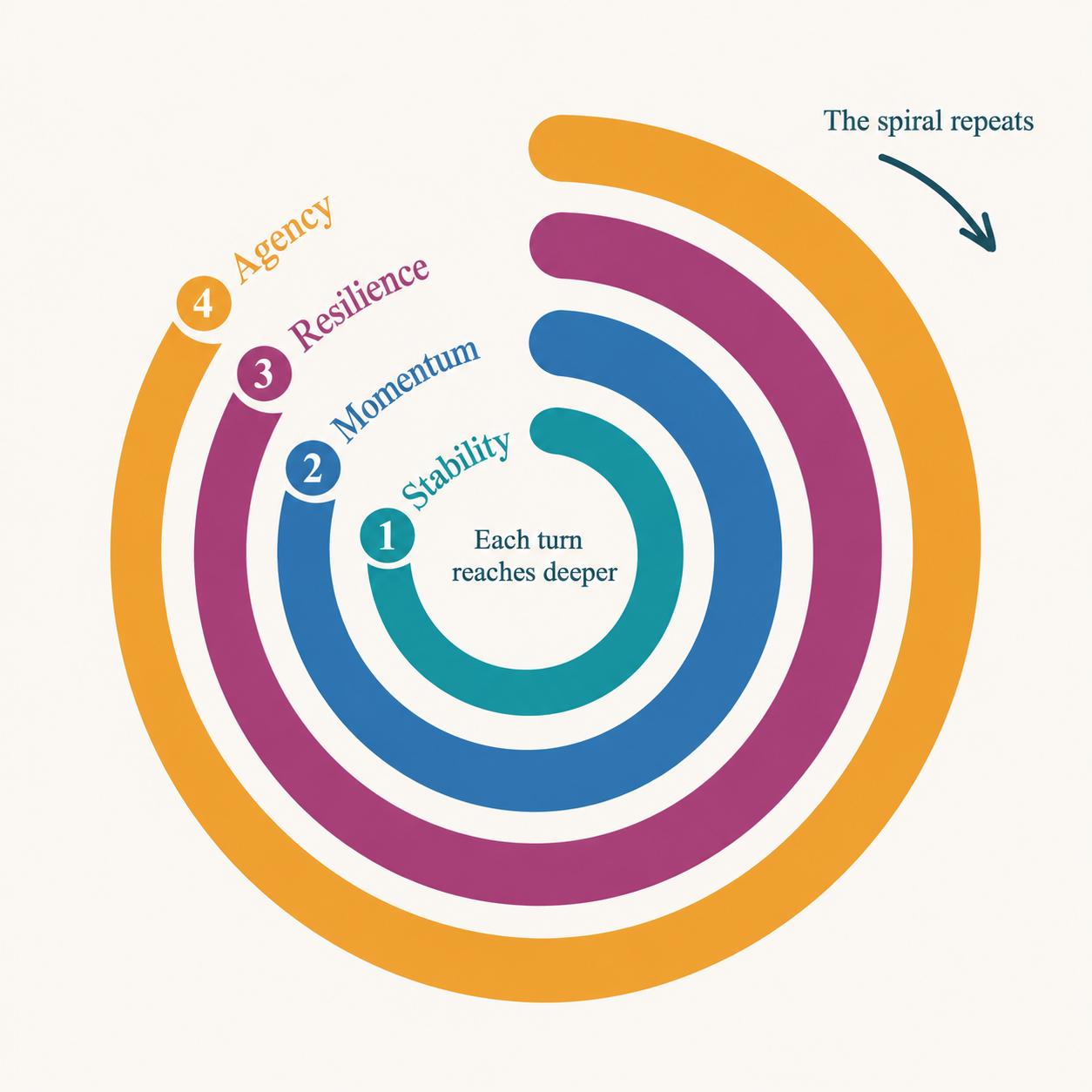
The STEPS Spiral
Four cycles of development, revisited at increasing independence.
The STEPS Spiral is not a level system and not a linear progression. A student moves through cycles repeatedly, at increasing independence. A student may be at Resilience in one domain and Stability in another simultaneously. The Spiral describes a quality of engagement, not a global status.
Stability
The student is building a regulatory baseline. Basic routines are not yet established.
- Skills are prompted by adults.
- Transitions require explicit preparation.
- Predictable structure matters most.
Adults do
- Provide the structure.
- Co-regulate actively.
- Interpret dependence as appropriate starting point.
Signs of movement
- The student anticipates routines.
- Task entry becomes quicker.
- Support can be reduced in familiar moments.
Common misconception: Stability is not weakness. It is foundation.
Momentum
The student has a baseline. Routines exist but are fragile.
- Prompted skill use is increasing.
- The student can name needs with guidance.
- Small repeated successes matter.
Adults do
- Prompt without rescuing.
- Increase challenge gradually.
- Celebrate consistency more than performance spikes.
Signs of movement
- Student begins spontaneous use of skills.
- Less cueing is needed.
- Confidence becomes visible.
Common misconception: Momentum is not mastery. It is fragile practice.
Resilience
The student can recover from setbacks. A difficult day does not derail the week.
- Skills are used independently in familiar contexts.
- Feedback can be received constructively.
- Recovery time shortens.
Adults do
- Step back.
- Offer support when asked.
- Name progress explicitly.
Signs of movement
- Recovery becomes quicker.
- The student tolerates challenge without collapse.
- Setbacks are treated as information.
Common misconception: Resilience does not mean the student no longer needs support.
Agency
The student initiates independently. Ownership is transferring from adult to student.
- Skills are initiated without prompting.
- The student monitors their own progress.
- The student supports peers using shared language.
Adults do
- Consult rather than direct.
- Celebrate initiative.
- Prepare for the next environment.
Signs of movement
- Student advocates before breakdown.
- Planning becomes more realistic.
- Ownership of systems becomes visible.
Common misconception: Agency does not mean the work is finished. The spiral repeats.